
BINNING

Binning processes for consistent and high-quality LED lighting

Binning in a nutshell:
Binning is crucial to ensure consistent quality of LEDs. It groups LED chips based on their power and color to ensure stable light output. Methods such as voltage, flux and color binning play a central role in this process. The CIE standard valence system, which models human color perception, and color temperature, which describes the color characteristics of light, are important concepts that are taken into account.
At ISOLED®, precise binning reduces the variation in color deviations, resulting in high quality and customer satisfaction.
Customer information
The ISOLED® knowledge "Sustainably constant light quality through binning" describes the binning process in the manufacture of LED chips. At ISOLED®, checking the binning is an essential part of quality assurance. • We define strict specifications for our CHIP suppliers and check all incoming goods for deviations outside the tolerance compared to the x and y coordinates ordered by us based on the CIE1931 diagram (standard valence system).
• Provided there is a corresponding stock quantity and availability, each order at ISOLED® is processed exclusively from a batch ID. This means that you receive all copies of your delivery with a binning of SDCM Step 1 (= SWE 1 barely measurable color difference).
• For technical production reasons, subsequent batches are subject to slight deviations from the previous batches, but we will only release them for sale if their deviation does not exceed SDCM Step 2-3 (= SWE 2-3 barely visible color difference).
This is our quality promise and guarantees stable light quality across all production batches in terms of color impression, CRI (ra) and luminous flux.
Quality standards for LED illuminants
LED technology is constantly changing, driven by customer requirements and the untapped potential of this technology. In addition to classic quality criteria such as reliability and cost-effectiveness, rapid product development is focusing in particular on increasing luminous flux, improving color rendering and ensuring consistent light quality.
The goals of binning:
- uniform light colors
- maximum and consistent quality with regard to all product characteristics over the entire service life
Binning
The key role in LED production
The industry aims to produce LED chips with consistent photometric properties across different production batches. Binning is the process by which LED manufacturers evaluate and group these chips to ensure they meet customers' high standards.
How does binning work?
Every LED chip has slight variations in luminous flux, color value and forward voltage. The binning process categorizes these chips according to their quality. In this way, they can be specifically installed in LED light sources to ensure consistent light quality and performance.
The advantages of binning for the customer:
a stable light quality from one production batch to the next a color impression and color rendering index in line with the specifications low derating (aging process) over the useful life in-house, certified measurement methods and sensor technology.
LED chips from each production batch exhibit deviations in terms of luminous flux output, color value and forward voltage. Binning is the process used by LED manufacturers to evaluate the individual LED chips and classify them into bins.
Based on this sorting process, the LED chips are categorized qualitatively and can therefore be installed in LED illuminants and LED luminaires in a targeted manner and tailored to the requirements. This ensures that the photometric performance values of the LED luminaires and LED illuminants are achieved and maintained for the specified service life.
Die Qualität von LED-Licht hängt nicht nur von der Technologie selbst ab, sondern auch von der präzisen Sortierung und Kategorisierung der LED-Chips. Dies wird durch verschiedene Binning-Methoden erreicht, die sicherstellen, dass LED-Leuchtmittel die gewünschten Lichtspezifikationen erfüllen.
Weiß ist nicht gleich weiß

Our ISOLED® binning process classifies LED chips in different steps, with Step 1 showing barely measurable color differences, while Step 2-3 tolerates minor and barely visible deviations.
ANSI Cree Chart: Standard ISOLED® colors include ultra-warm white, warm white (2700 K), warm white (3000 K), natural white (4000 K), cool white (5500 K)
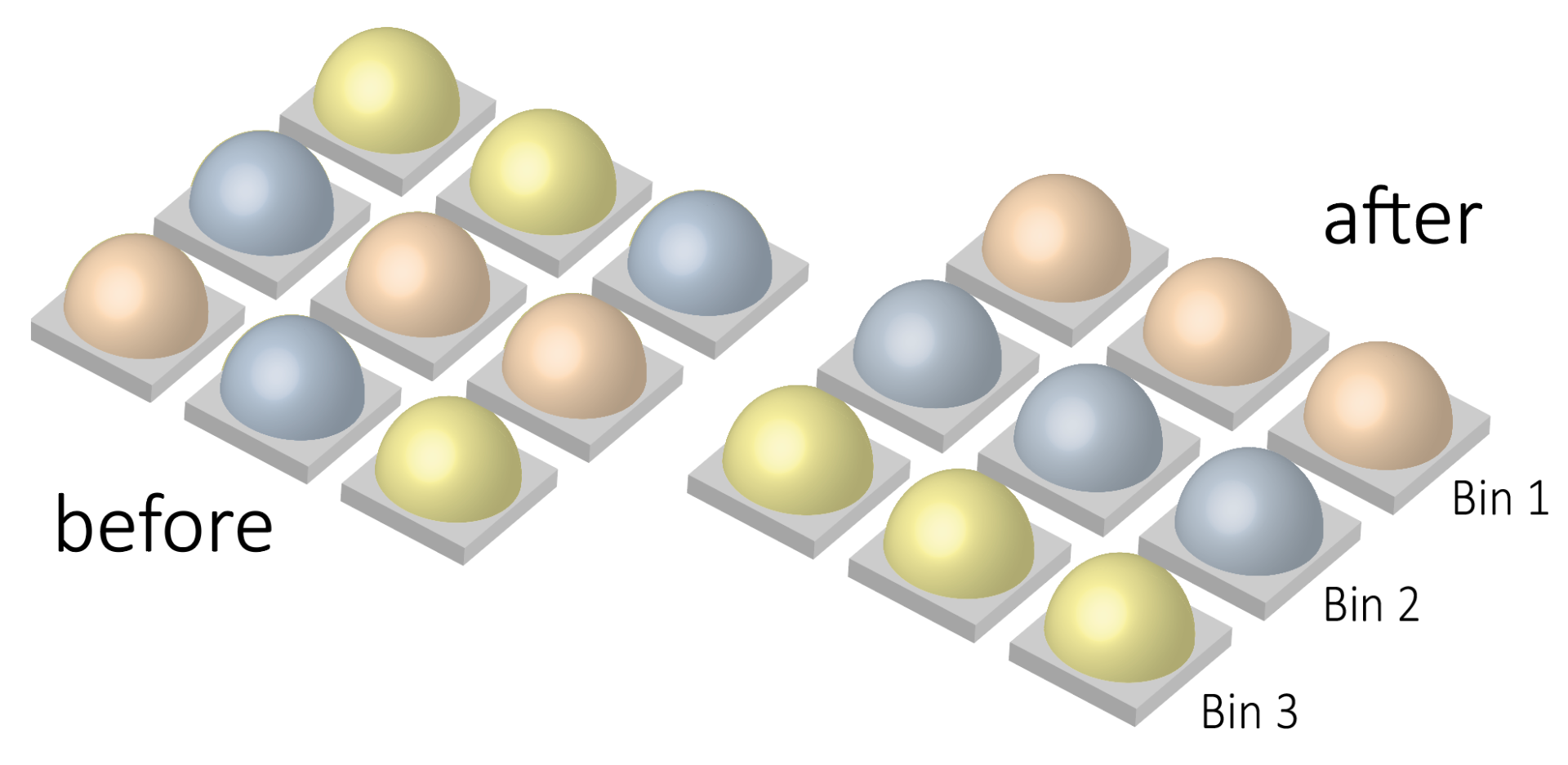
Binning is an essential step in LED production that ensures sustainable and consistent light quality. Through the targeted selection and categorization of LED chips, manufacturers and customers alike can benefit from improved LED illuminants.
Binning methods:
Voltage Binning
The LED chips are measured individually and sorted according to their forward voltage (volts). By grouping chips with similar voltage values, manufacturers can ensure consistent performance.
Flux Binning
To ensure a uniform luminous flux, the LED chips are divided into bins according to their actual lumen values. This makes it possible to achieve uniform light output across different batches.
Colour Binning
The basis for color binning is the CIE standard valence system. The international lighting commission (CIE - Commision internationale de l‘éclairage) has defined this standard valence system or standard color system in order to link the physical cause of a color stimulus and human color perception, to describe it objectively and to capture it graphically in its entirety.
After entering the colour coordinates in the CIE standard valence system (also CIExy diagram), the white LED chips are characterized and classified according to colour location and colour temperature, while the coloured LEDs are classified according to colour location and dominant wavelength (peak wavelength).

dimension of the
macadamellipsis
Quality of
color homogeneity
1 SWE
*No perceptible
color difference
2- 3 SWE
*Barely perceptible
color difference
> 4 SWE
*Visible color
difference
* Color difference visible to the human eye, not or barely perceptible
The MacAdam ellipses are sized using the SDCM (Standard Deviation of Color Matching) in threshold value units (SWE).
The EU Ecodesign Regulation stipulates color consistency for manufacturers and distributors of LED light sources and LED lamps. Accordingly, the maximum deviation of the color value components within a MacAdam ellipse must not exceed six levels (6 SWE).
Voltage binning, flux binning and color binning enable manufacturers to ensure consistent light quality across different production batches. These methods are essential for the production of high-quality LED illuminants and contribute to customer satisfaction.
CIE standard valence system and color temperature:
key concepts for light quality
CIE standard valence system
The CIE norm valence system is a standard for the objective description of colors and their perception by the human eye. The MacAdam ellipses are used to define the tolerance and accuracy of color rendering. The smaller the sector within the MacAdam ellipse, the smaller the color differences that can be perceived by the human eye.

Color temperature
The color temperature of a light source describes the color impression it creates and is measured in Kelvin. It is based on the color spectrum of a black body, which emits different colors at different temperatures. A low color temperature (e.g. 2700 K) corresponds to warm light with reddish tones, while a high color temperature (e.g. 5500 K) produces a cool, bluish light.
Significance for the LED industry:
The CIE standard valence system and color temperature play a crucial role in the quality assurance of LED products. They enable manufacturers to produce products with consistent light quality that meet customer requirements.
The CIE standard valence system serves as a standard for the objective description of colors, while the color temperature quantifies the color impression of a light source. Both concepts are crucial for developing high-quality LED products and ensuring consistent light quality.
Characteristic light colors according to DIN 5035
Light source
Warm white
Neutral white
Daylight white (also cold white)
Color temperature in Kelvin
< 3.500 K
< 5.300 K
> 5.300 K

dimensions of
the macadam ellipses
Quality of color
homogeneity
1 SDCM(SWE)
*No perceptible
color difference
2- 3 SDCM(SWE)
*Barely perceptible
color difference
> 4 SDCM(SWE)
*Visible color
difference
* color difference visible to the human eye, not or barely perceptible
The MacAdam ellipses are sized in threshold value units (SWE) using the SDCM (Standard Deviation of Color Matching).
The EU Ecodesign Regulation stipulates color consistency for manufacturers and distributors of LED light sources and LED lamps. Accordingly, the maximum deviation of the color value components within a MacAdam ellipse must not exceed six levels (6 SWE).
Frequently Asked Questions about Binning & LED Color Quality
At ISOLED, "binning" refers to the systematic sorting of LED chips according to output, color, and forward voltage. Because each chip naturally shows small variations, binning allows us to group similar chips into bins so that individual LEDs or luminaires produced from the same bin are virtually identical in color and performance. This ensures stable light quality across production batches and prevents visible color differences.
We use three main criteria:
- Voltage Binning: Sorting according to forward voltage
- Flux Binning: Sorting according to luminous flux (lumen value)
- Colour Binning: Classification based on color coordinates in the CIE chromaticity system (CIExy or MacAdam ellipses)
ISOLED places high importance on tight color tolerances: deliveries are ideally made with SDCM Step 1 (SWE 1 – hardly measurable difference). In exceptional cases, deviations up to SDCM Step 2–3 are permissible (SWE 2–3 – barely visible difference). Every order is preferably fulfilled from the same batch ID to ensure color consistency.
This slogan emphasizes that two LED luminaires, both nominally e.g., 4000 K, may still show visible color differences if they do not come from the same bin. Through strict binning, we ensure these differences remain minimal and barely noticeable to the observer.
Tight binning reduces early variations between LED chips caused by aging processes. Because all chips in a bin have similar characteristics, they age more uniformly. This helps maintain color appearance, luminous flux, and CRI stability throughout the product’s lifetime.
Assuming sufficient stock and storage capacity, every customer order is fulfilled exclusively from a single batch ID. This means all delivered units come from one bin (e.g., SDCM Step 1), preventing color deviations within the delivery.
In such cases, we strictly check that deviations in color coordinates do not exceed SDCM Step 2–3. Only if this tolerance is met do we release the batch for sale, ensuring consistent perception across batches.
For incoming goods and quality assurance, we use certified measurement methods and sensors, particularly using the CIE1931 diagram to check x and y coordinates (chromaticity). Deviations outside the tolerances lead to batch rejection.
- Uniform light color across all series and batches
- Maximum, consistent quality of all products over their lifetime
- High color rendering index (CRI) and continuously defined luminous flux
- Customer trust through consistent delivery and color quality
The EU Ecodesign Regulation requires color deviations to be within a MacAdam ellipse of no more than 6 SWE (SDCM 6). Our binning specifications (SDCM 1 up to a maximum of SDCM 3) are well below this, exceeding legal minimum requirements.
Yes – depending on availability and technical feasibility, we can accommodate a specific binning requirement (e.g., SDCM 1). This is coordinated in the order, and we then deliver the corresponding batches.
Register now!
Join our community and get exclusive access to high-quality content.
Do you have any questions?
If you have any questions about binning, we are here for you! Fill out our form and we will get back to you as soon as we have processed your request.