
DALI
Digital Addressable Lighting Interface
DALI - SIMPLE, INDIVIDUAL AND COST-SAVING!

Dali in a Nutshell:
DALI (Digital Addressable Lighting Interface) is a manufacturer-independent standard for controlling dimmable lighting systems in building automation. It enables simple installation, individual adaptation and cost-efficient control of up to 64 devices per system. The DALI bus system offers bidirectional communication, high interference immunity and flexible cabling options without the need for special power supply units or group wiring.
Intelligent light management
DALI (Digital Addressable Lighting Interface) was developed by a working group of the German Lighting Association (ZVEI) and is a manufacturer-independent international interface standard for dimmable electronic control gear Electronic control gear.
DALI is used in the building automation sector for simple and uncomplicated control of lighting solutions at room level. Integration into building-wide systems such as KNX (higher-level field bus for cross-room building automation) is possible via bridges. KNX (higher-level field bus for cross-room building automation) is possible via bridges.
Lighting scenes perfectly adapted to use
The operating devices (such as sensors, electronic operating devices, luminaires etc.) with a DALI interface are assigned unique DALI short addresses, which the DALI control unit (or the DALI gateway) uses to query the status of the illuminants and operating devices and set them to the desired operating status (switch on/off, dimming level).
Up to 16 lighting scenarios can be defined, programmed and thus realized with the DALI lighting management system can be realized.
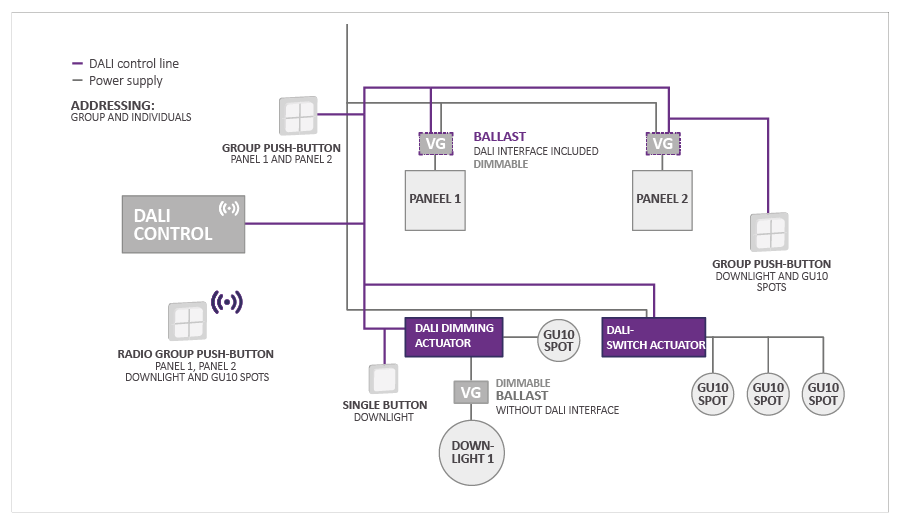
Max. 300 metres of DALI control line
Up to 64 operating devices can be connected
Up to 16 groups
16 lighting scenarios can be realised
Simple planning and cost-effective installation
The DALI bus system has established itself on the market compared to the common 1-10 V standard (ECGs with analog 1 to 10 V interface) and is also regarded as the successor to the DSI + (Digital Serial Interface). DALI impresses with a significantly greater range of functions, very simple handling and cost-effective installation. In contrast to these two systems, with the DALI bus system each individual operating device can have different intensity control values and each reports these back (bidirectional information flow). With the 1-10 V standard and DSI, only a unidirectional flow of information is possible (from control unit to operating device).
High interference immunity and a wide range of structural options for cabling
The DALI bus system works with a serial, asynchronous data protocol (transmission rate 1200 bit/s at a voltage level of 16 V). This ensures a high level of interference immunity and allows the two outdoor cores of the 230 V cable heads to be used for the DALI bus -> simple and cost-effective installation! The cables for data transmission can be laid in star, line or tree form, whereby the maximum distance between two system components cannot exceed 300 m, depending on the cable cross-section.
No terminating resistors are required at the ends of the cables. No ring-shaped connection of components! In contrast to conventional cabling, where all the luminaires in a line can only be switched and dimmed synchronously, with the DALI system the assignment of switches and luminaires can be changed at any time without rewiring.
Less effort Fewer components Simple programming
- Up to 64 actuators/operating devices can be controlled individually or/and in max. 16 groups per DALI bus system via a 2-wire control line - NO group wiring or relays required!
- Each operating device has its own DALI short address, is programmed centrally, can be assigned to several groups and can perform tasks synchronously within these groups or be controlled for individual settings
- Max. 16 light scenes (intensity control values) can be defined and saved per DALI operating device - when a light scene is called up, all DALI ECGs reach their dimming setpoint synchronously
- Max. 250 mA current consumption per DALI bus.
- Up to 2 mA current consumption per DALI load (DALI actuator) - this means that the operating devices do not require their own power supply units
- Max. Voltage drop between transmitter unit and actuator NOT below 2 V
- Max. 300 m length of connecting cables when using conductors with 1.5 mm² Querschnitt (Note: If the maximum length of 300 m is required, then the combined use of the mains cable is not recommended)
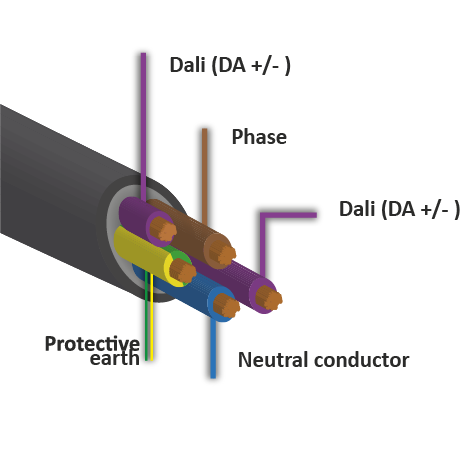
- The "outdoor" cables of a 5 x 1.5 mm²-NYM cable of the mains supply (230 V) can be used as control cables
- The polarity of the control cables does not have to be observed with DALI ballasts
- No ring-shaped installation type of the DALI bus system possible - otherwise cables in almost all topologies are possible!
Provided that the required Isolation conditions (double insulation) are met, the "outdoor" cable heads of a 5 x 1.5 mm²-NYM cable from the mains supply (230 V) can be used for the control cables of the digital interface. See image. Big advantage: The DALI bus system does not require its own connecting cables and can therefore be installed very easily and cost-effectively.
Everything You Need to Know About DALI Control
DALI (Digital Addressable Lighting Interface) is a manufacturer-independent standard for digital, addressable control of lighting systems. We integrate DALI into many of our LED products to enable individual control, high flexibility, and feedback – e.g., for scene control, automatic adjustments, and energy-efficient lighting.
A DALI bus can operate up to 64 devices (luminaires or ballasts). This allows you to centrally control extensive lighting segments.
DALI allows up to 16 light scenes (intensity levels) per device. This enables you to predefine modes such as office, presentation, cleaning, or night mode and activate them at the push of a button.
The cable length can be up to 300 meters (with typical cross-sections). The DALI bus allows star, line, or tree topology – ring topology is not permitted. Data is transmitted via a 16 V protocol, which ensures high immunity to interference.
Each DALI bus has a maximum current of 250 mA, and a single DALI device (actuator) up to 2 mA. This means most devices do not require separate power supplies for the control current.
Bidirectional communication: Each device reports its status – e.g., dimming level, errors
Individual control: Devices can be addressed individually, not just collectively
Scene functionality: Multiple predefined light scenes can be controlled
Easy installation: No additional wiring is needed since the bus can run parallel to the power supply.
All this makes DALI more powerful, flexible, and future-proof than traditional analog systems.
DALI is designed so that the control cable can be run together with the standard 230 V power line. This means no separate control cable is required.
In practice, a 5-core standard cable (e.g., NYM 5×1.5 mm²) is often used. Two cores carry the DALI control, while the other three supply mains power to the luminaires. This allows both power and control signals to be transmitted via the same cable – clean, space-saving, and without extra installation effort.
Important: the cable length should not exceed approximately 300 meters, and the voltage drop in the DALI bus should not fall below 2 volts. This ensures reliable and interference-free communication between devices.
Yes – the maximum voltage drop between the DALI master and actuator must not fall below 2 V. It is also recommended to ensure sufficient conductor cross-section for longer cables (up to 300 m).
Yes – DALI can be integrated into KNX (and other fieldbus systems) using DALI/KNX gateways. This allows centralized linking of lighting control and building automation.
Our DALI-enabled products feature digital drivers that interpret DALI commands (dimming, switching, scene changes). Each device receives a unique DALI short address, enabling flexible control. Our integration ensures that DALI components work optimally with our luminaires.
DALI uses an asynchronous serial data protocol (1,200 bit/s) at 16 V, which is robust against interference. Furthermore, the bus can be run parallel to mains power without sensitive data lines.
Through our contact page, you can reach a qualified inside-sales expert who will support you in planning, addressing, programming, and integrating DALI systems into your project.
Register now!
Join our community and get exclusive access to high-quality content.
Do you have any questions?
If you have any questions about Digital Addressable Lighting Interface, we are here for you! Fill out our form and we will get back to you as soon as we have processed your request.