
VOLTAGE LOSS
Avoiding voltage loss when installing LED-flex stripes


Voltage loss in a nutshell:
The ideal voltage loss when supplying flex stripes should be less than 3%, which can sometimes only be achieved by increasing the cable cross-section of the voltage supply. Some DIN rail transformers offer the option of increasing the output voltage by up to 10% in order to ensure sufficient voltage at the feed-in point even with long supply cables, e.g. from the distribution cabinet to the living room. Wherever possible, additional feed points are advisable to avoid voltage and light losses across the entire light line.
Ideally, the voltage loss when supplying flex stripes should be less than 3%. In practice, this can often only be achieved with large cable cross-sections. Some transformers, e.g. all grid transformers in the ISOLED® range, offer the option of adjusting their output voltage upwards by up to 10% to ensure 12 V or 24 V at the first power feed point even with long supply cables. The following table shows the voltage losses to be expected:
| LENGTH OF SUPPLY CABLE | VOLTAGE DROP/LOSS ON THE COPPER SUPPLY CABLE LOAD: 5 M ROLL OF 24 V LED FLEX STRIPE WITH 14.4 W/M | |||||||
|---|---|---|---|---|---|---|---|---|
| 0,50 MM² | 0,75 MM² | 1,00 MM² | 1,50 MM² | |||||
| VOLTAGE | LOSS | VOLTAGE | LOSS | VOLTAGE | LOSS | VOLTAGE | LOSS | |
| 1,0 m | 23,79 V | 0,21 V | 23,86 V | 0,14 V | 23,89 V | 0,11 V | 23,93 V | 0,07 V |
| 3,0 m | 23,36 V | 0,64 V | 23,57 V | 0,43 V | 23,68 V | 0,32 V | 23,79 V | 0,21 V |
| 5,0 m | 22,93 V | 1,07 V | 23,29 V | 0,71 V | 23,46 V | 0,54 V | 23,64 V | 0,36 V |
| 7,5 m | 22,39 V | 1,61 V | 22,93 V | 1,07 V | 23,20 V | 0,80 V | 23,46 V | 0,54 V |
| 10,0 m | 21,86 V | 2,14 V | 22,57 V | 1,43 V | 22,93 V | 1,07 V | 23,29 V | 0,71 V |
| 15,0 m | 20,79 V | 3,21 V | 21,86 V | 2,14 V | 22,39 V | 1,61 V | 22,93 V | 1,07 V |
| 20,0 m | 19,71 V | 4,29 V | 21,14 V | 2,86 V | 21,86 V | 2,14 V | 22,57 V | 1,43 V |
| 30,0 m | 17,57 V | 6,43 V | 19,71 V | 4,29 V | 20,79 V | 3,21 V | 21,86 V | 2,14 V |
Formula for calculating the
voltage drop with DC voltage
2 · length (l) · current (I)
Voltage (U) = Conductivity copper (56) · Cable cross-section
(A in mm2)
Copper conductivity(σ in S/m): 56 - 106 (the value depends on the purity of the material)
In order to avoid excessive heat generation, we recommend the following for the power supply of
LED-flex stripes should remain below 3 amps per feed contact!
Current per feed contact in A (I)
=
Flex strip power in W/m (P) · length in m (served by one feed contact)
Operating voltage in V (U)
| Power Flex stripe |
AFTER 5 M LENGTH | |
| VOLTAGE | VOLTAGE | |
| 4,8 W/m | ca. 23,3 V | ca. 0,7 V |
| 9,6 W/m | ca. 22,6 V | ca. 1,4 V |
| 12,0 W/m | ca. 22,2 V | ca. 1,8 V |
| 14,4 W/m | ca. 21,9 V | ca. 2,1 V |
| 14,4 W/m | ca. 20,7 V | ca. 3,3 V |
| 14,4 W/m | ca. 19,8 V | ca. 4,2 V |
The voltage loss in the supply cable and on the flex stripe board is halved or reduced
- when using a flex stripe with 7.2 W/m instead of 14.2 W/m i.e. with lower LED power;
- when operating at a higher voltage, i.e. using 24 V DC instead of 12 V DC LED-flex stripes.
The voltage loss of the supply cable and on the flex stripe board is doubled or elevated
- when using a flex stripe with double or higher power W/m;
- when operating at a lower voltage, e.g. when using a 12 V LED-flex stripe.
APPLICATION TIP - ADDITIONAL INFEED
Even if the transformer in complex installations such as escalators does not have to be positioned centrally as in the ideal case, but further away, the following sketches describe options for efficiently infeeding the current and thus avoiding different levels of light emission over the entire length of the light strip:
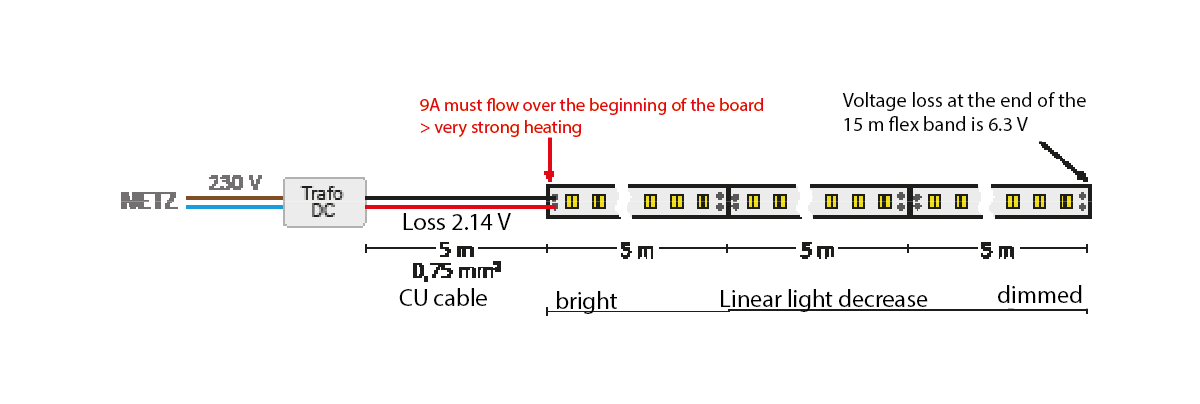
Beispiel: 24 V LED Flexband mit 14,4 W/m (Gesamt 216 W auf 15 m)
3 rolls each 5 m long (light line therefore 15 m in total) Supply cable: copper cable heads 5 m long
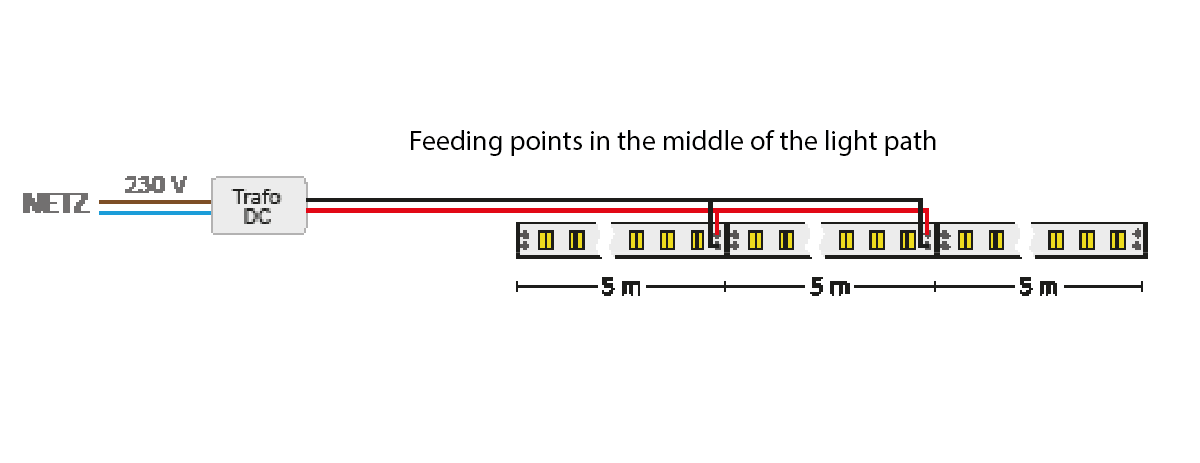
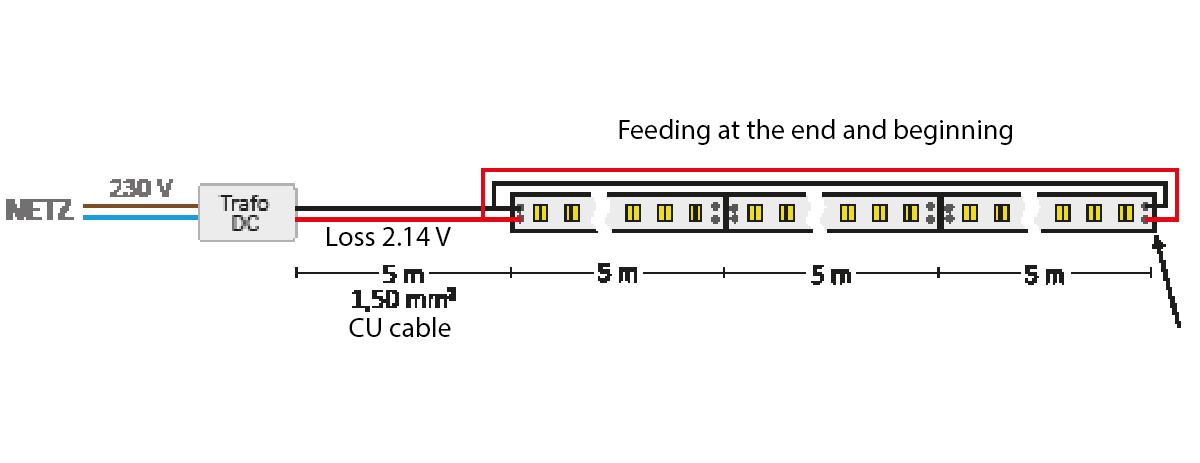
With additional feed points, which are realized by a sufficiently in size cable, one avoids
-
Voltage losses,
-
Light losses and
-
overheating of the LED boards (maintaining the intended service life!).
Single-sided infeed - NOT RECOMMENDED!


Tip 1 Parallel feed points at 5 m and 10 m along the light line
Tip 2 Additional infeed at the end of the Light path
Notice
If the LED flex strip is properly mounted on heat-dissipating substrates (e.g. aluminum profile), the surface temperature never rises above 50°C!
Excessive temperatures mean a rapid reduction in the the service life.
The thermal conductivity of various substrates must be taken into account: the heat absorption of e.g. stainless steel and coated sheet metal is far lower than that of aluminum.
Frequently Asked Questions About Voltage Drop in LED Systems
Voltage drop refers to the reduction of operating voltage along the power supply of an LED flex strip. For LEDs, operating voltage is crucial for brightness, color stability, and lifespan. Even a voltage drop of more than 3 % can lead to uneven light distribution, color shifts, and higher heat generation on the PCB. This can significantly shorten the lifespan of LEDs and reduce energy efficiency. Voltage drop must be carefully controlled, especially for long feed lines in installations such as offices, retail spaces, or escalators.
Cable length: Longer cables increase resistance, so voltage drop rises proportionally.
Cable cross-section: Larger cross-section reduces resistance and voltage drop.
LED power: Higher watts per meter increase current demand and voltage drop.
Operating voltage: 24 V systems require half the current of 12 V systems at the same power, reducing voltage drop.
Copper quality: Pure, highly conductive copper reduces resistance.
Feed points: Multiple feeds reduce the voltage difference along the strip.
Increase cable cross-section: Standard at least 1 mm² for longer feed lines, up to 1.5 mm² or more for very long runs.
Multiple feed points: For longer light lines (e.g., >10 m), feed the line in sections to compensate for voltage drops.
Use 24 V systems: Halves the current at the same power and significantly reduces voltage drops.
Adjustable transformers: Some ISOLED DIN-rail transformers allow a voltage increase of up to 10 % to optimize voltage at the first feed point.
Lower-power flex strips: Reduced wattage per meter (e.g., 7.2 W/m instead of 14.4 W/m) reduces voltage drop proportionally.
With one-sided feeding, the entire current flows through the flex strip in one direction. For longer light lines, this leads to higher voltage at the start and a significant drop at the end. The result: uneven brightness, color deviations, and possible overheating at the end of the strip.
ISOLED therefore recommends:
- Multiple feed points evenly distributed.
- Segment light lines for complex installations like escalators or long halls and feed each roll separately.
- Use adequately sized cables between transformer and feed points.
Formula:
UDrop = 2 ⋅ l ⋅ I / (σ ⋅ A)
l: length of the cable (m)
I: current (A)
σ: copper conductivity (56·10⁶ S/m for pure copper)
A: cable cross-section (mm²)
This calculation enables precise planning of the supply line to minimize voltage loss and ensure uniform light quality.
The higher the power per meter, the greater the current demand and therefore the voltage drop:
Example: 14.4 W/m LED flex strip over 5 m → voltage drop approx. 2.1 V with 1 mm² cable.
Reducing to 7.2 W/m halves the current, thus also reducing voltage drop and heat generation.
For B2B customers: For energy-intensive installations such as store lighting or industrial facilities, cable cross-section, feed points, and transformer must be carefully dimensioned.
ISOLED primarily recommends 24 V systems, as they require less current at the same power, significantly reducing voltage drop.
12 V systems are only suitable for short runs or low power.
For long runs (>10 m), 24 V systems improve planning, reduce heat load, and ensure color and brightness stability.
Overheating occurs due to excessive current caused by voltage drop or high load per feed point. ISOLED recommends:
- Keep current per feed point 3 A.
- Use multiple feeds for long light lines.
- Use cooling profiles or aluminum channels to improve heat dissipation.
- Lower power per meter (e.g., 7.2 W/m) for long runs.
This ensures the intended lifespan of up to 50,000 h for ISOLED products.
Example: 24 V LED flex strip, 14.4 W/m, total length 15 m (3×5 m rolls)
- One transformer feeds each roll separately.
- Copper cable sufficiently dimensioned (1.0–1.5 mm²)
- Result: No voltage drops >3 %, even brightness along the entire light line, no overheating.
Output voltage adjustable up to +10 %.
Allow long feed lines without quality loss.
Simplify project planning for complex installations like corridors, escalators, or hall lighting.
Optimal combination with multiple feed points for uniform light distribution.
High-purity copper reduces resistance and voltage drop.
Low-quality copper or thin cables increase voltage loss and heat generation.
For B2B installations, ISOLED always recommends tested, high-quality cables and components.
Do you have any questions?
If you have any questions about voltage loss, we are here for you! Fill out our form and we will get back to you as soon as we have processed your request.
Register now!
Join our community and get exclusive access to high-quality content.