
THERMALMANAGEMENT
LED thermal management Effects on light quality and longevity

In Short:
The thermal management of LEDs is crucial for the light quality and service life. LED chips develop faults over time, which leads to degradation, i.e. the light output continuously decreases. The useful life of LEDs depends on operating hours and factors such as temperature, power supply and material quality and is considered independently of the warranty period.
Degradation
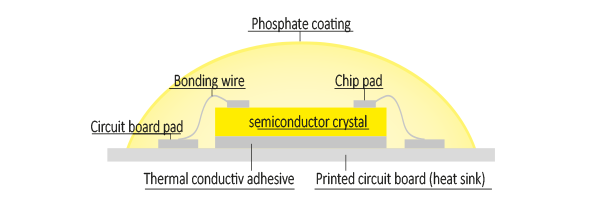
During the normal ageing process of an LED chip, imperfections appear on the semiconductor crystal. The increasing number of imperfections leads to a non-linear decrease in the light output of the LED illuminant or the LED luminaire with integrated LED chip. This reduction in luminous flux is called degradation.
In contrast to conventional illuminants, which suddenly fail at the end of their service life, LEDs continuously lose luminous flux and therefore shine less and less brightly. This is why LEDs are not referred to as having a service life but a nominal or useful life (certain minimum luminous flux at a defined point in time).
Useful life = operating hours = period in which the lighting solution can still be used sensibly with the light output still available (decreases over the years).
Background: In many projects and tenders, a useful life of at least 50,000 hours is required for products under the aspect L80|Bxx.
Lifespan versus guarantee
The service life commercially available refers to the LED chip used and its current supply. It is independent of the warranty period, which begins on the day of delivery + 10 days from us to the customer.
The warranty claim consists exclusively within the warranty period and regardless of whether the product has been in operation for 30,000 hours or has never been put into operation at all!
PS: The starting point for the guarantee specified by us is in particular the guarantee period which we are granted by our supplier for the respective product. For reasons of reinsurance, our guarantee to the customer cannot generally be longer.
The service life of LEDs is significantly influenced by the following factors:
-
Operating and ambient temperatures
-
Power supply (driver current)
-
Herstellungsprozess der LED Chips
-
LED Chip-Komponenten und eingesetzte Materialien
-
Elektronik
-
Beschaffenheit und chemische Zusammensetzung des Silikons, das im LED Chip als Linse dient
-
Qualität des eingesetzten Phosphors sowie das Verfahren, mit dem es aufgebracht wird
Artificial ageing process in continuous test operation
First, the luminous flux of an LED illuminant or the luminaire with integrated illuminant (permanently installed) is measured in the integrating sphere. This is followed by 6,000 hours of long-term test operation in a climatic chamber with a constant ambient temperature. To simulate the ageing process, the LEDs are exposed to constant temperatures of 55° C, 85° C and a temperature freely selectable by the manufacturer (25° C for ISOLED®). Random samples are taken at least every 1,000 hours for intermediate measurements of the luminous flux.
The values determined during continuous test operation form the basis for additional calculations of the valid forecast of luminous flux maintenance using the TM-21 method. If the average values from the various measurement data are entered into the xy coordinate system as prescribed in the TM-21 method, they produce an exponential curve (x = operating hours; y = luminous flux in %).
Test method for classifying the rated service life of LEDs (LM-80, TM-21)
The rated service life of ISOLED® illuminants and luminaires is determined and defined using the manufacturer-independent LM-80 method or in accordance with the TM-21 standard.
The LM-80 method is a standardized industry standard that is used to determine the luminous flux reduction of LED illuminants and LED luminaires. This procedure specifies in detail how and under what conditions (above all defined ambient temperatures) illuminants must be tested in order to provide valid comparative data for calculating the rated service life using the TM-21 procedure.
TM-21 method
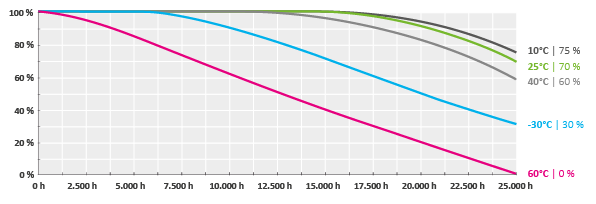
Luminous flux loss under the influence of different ambient temperatures Measurement results refer to the rated service life of 25,000 operating hours ISOLED® quality standard is L70(6K)/B10
Determining the lifespan
From the Catalog 2024 When developing a chip type, the chip manufacturer uses the TM21 or LM80 method to determine its useful life over a test period of at least 3000 to max. 9000 hours and logarithmically extrapolates the values measured after this "short" period of derating (ageing process).
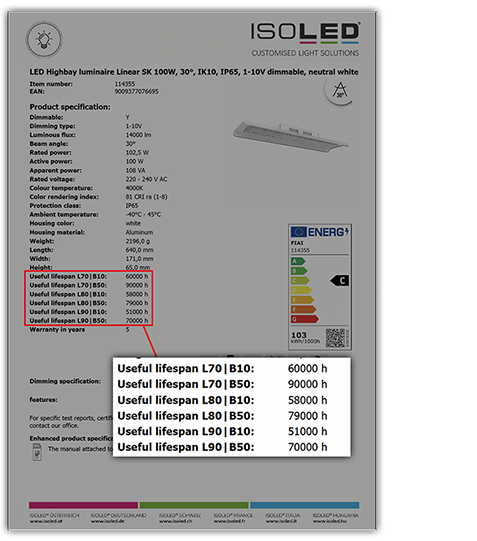
To date, we have indicated the useful life of our products on their packaging, in the catalog and in the store under the aspect L70|B10.
This means that we ask the chip manufacturer after how many operating hours 10% of the specimens in the test still have a luminous flux (=lumen) of less than 70% of the original value and therefore 90% still have more than 70% of the original lumen value.
A formula can be used to convert the useful life to the other aspects (ways of looking at things).·
From the Catalog 2024 and step by step on the packaging of newer production batches, we will be guided next year by the EU and its Ecodesign Regulation 2019/2020, in which "service life" is understood to mean a specification under the aspect L70|B50.
If it is then stated when 50% of the units have a luminous flux below 70% of the original output after the specified period, the printed hourly figure is naturally higher than with the current L70|B10 aspect - whether such a specification is appropriate and the lighting solution with such a reduced luminous flux can really still be used sensibly until the end of this period is debatable with a specification with L70|B50.
Until this is the case, the data sheets of our articles contain useful life information on 6 different aspects:
The TM-21 method for determining the useful life of LED illuminants is still valid, but has been further developed through updates. The most recent standard is ANSI/IES TM-21-21, which has been revised to provide additional refinement to the formulas used to calculate lumen maintenance.
TM-21 projects lumen maintenance based on LM-80 data collected over at least 6,000 hours. It provides a standardized method to predict the expected service life of LEDs at various temperatures and operating currents. The latest revisions of the TM-21 standard, including TM-21-19 and TM-21-21, have introduced additional interpolation methods to improve the accuracy of the projections, especially when the operating temperature and current do not exactly match the LM-80 test conditions.
Note
The calculated useful life must not exceed six times the duration test period. Otherwise, the test duration must be extended. E.g. In order to be able to specify a rated service life of 50,000 hours according to the LM-80 test, a continuous test operation of at least 8,333 hours must be carried out.
For ISOLED® L80/B50!
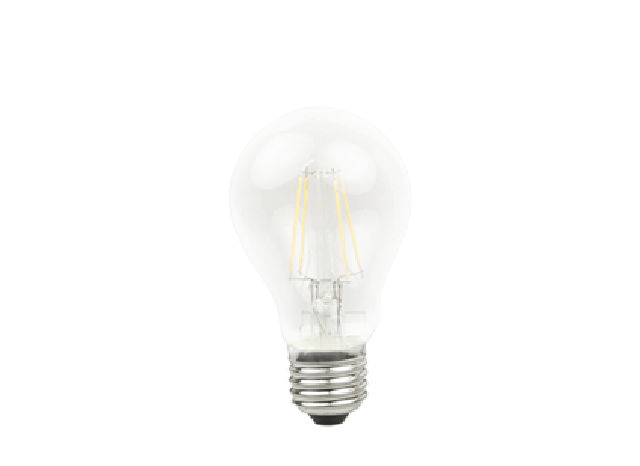
The ISOLED® quality standard for the service life of LED illuminants/luminaires is L80/B50. This value states, (L80) that the luminous flux (lumen) of an LED illuminant/luminaire does not fall below 80 % of the defined output value at the end of the specified rated service life (specified in the product data sheet).
Example: E27 LED bulb 8 W | 1,000 lumens | operating hours according to data sheet: 20,000 h
After 20,000 operating hours, 100 % of these E27 LED bulbs still emit at least 700 lumens of luminous flux. At least 90 % of all articles of this product type are significantly more powerful and produce more than 700 lumens.
How to improve the service life of LED luminaires
Full rated service life with correct thermal management
1. Observe and adhere to the manufacturer's specifications with regard to ambient temperature limits!
2. Ensure sufficient natural air circulation (convection)!
a. Closed LED luminaires: Ideally, the warm air must be able to escape upwards through an opening or be dissipated via an integrated thermal bridge or heat sink. Maintain the spacing between the illuminant and housing in accordance with the manufacturer's specifications. Do not cover the backs of integrated heat sinks!
b. LED recessed luminaires in the building fabric or suspended ceilings: Allow for sufficient space between the rear heat sink and the building fabric for heat exchange - DO NOT cover with insulation or other materials!
3. Avoid prolonged direct and indirect (via reflectors such as reflective metal or glass surfaces) solar irradiation!
Note: Physical late effects
Curiously, the physical damage and impairments to the LED illuminant/light caused by excessive temperatures (e.g. defects in the dielectric of the installed capacitors) may only become noticeable at sub-zero temperatures. The illuminants may start to flash as the forward resistance of the capacitors and ICs may have changed.
Natural convection and cooling
LED chips and the entire electronics of an LED illuminant/light generate heat during operation. In some cases, temperatures of up to 70° C are reached inside a closed luminaire, even in the case of intelligent/efficient heat dissipation, e.g. through an integrated heat sink.
In outdoor areas, LED luminaires can reach indoor temperatures of more than 80° C even when switched off, e.g. on sunny days. They are exposed to external influences such as exterior air temperature and direct and indirect (through metal, glass and other reflective surfaces) solar irradiation . The metal/glass housing is thus warms up even more.
If LED illuminants are operated at too high or too low an too high or too low an ambient temperature, this this has a considerable negative impact on performance, light color and service life! Particularly the LEDs typically used in LED illuminants typically installed in LED light sources, electrolytic capacitors and driver ICS suffer from this.
In any case, natural air circulation or cooling to maintain a balanced thermal balance! Thermal balance must be ensured!
Frequent effects due to high ambient temperature
-
Increased flickering (subconsciously perceptible)
-
Visible flashing (consciously perceptible)
-
Audible whirring
-
Massive deterioration in color rendering (CRI value drops)
-
Color location shift (the color temperature becomes significantly colder)
-
High inrush currents
-
Worsened dimming behaviour
-
Partial to complete failure of LEDs
-
chips
-
Burnout of LED chips
These negative effects can occur even after a very short operating time.
Please therefore observe our recommended ambient temperatures in the data sheets!
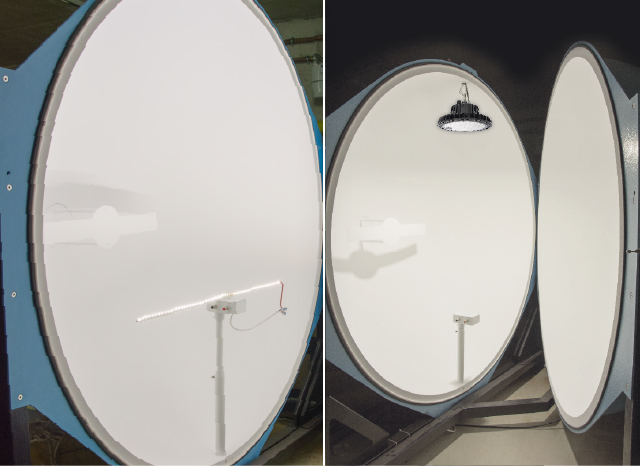
Sowohl im Rahmen der obligatorischen QS-Tests als auch zur Klassifizierung der Nennlebensdauer werden bei ISOLED® sämtliche LED Leuchtmittel/Leuchten mit integriertem LED Chip in einer der beiden Ulbrichtkugeln (Durchmesser 0,5 m und 1,7 m) gemessen.

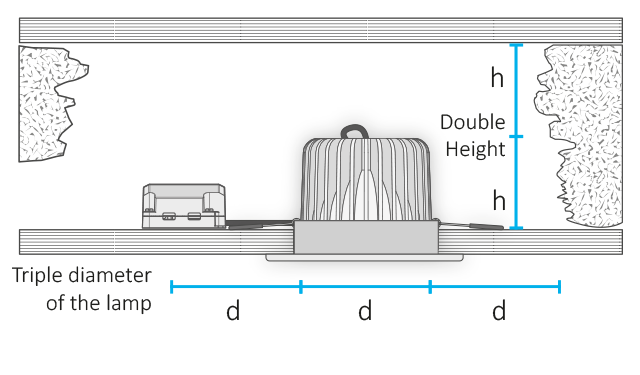
RECOMENDATION
Double Height | Triple diameter
Working life converter
After the specified operating hours h (= useful life), this is how many B% of the units supplied have a luminous flux that is below L% of the original lumens.
Results:
U_stundenL70B50:
U_stundenL80B10:
U_stundenL80B50:
U_stundenL90B10:
U_stundenL90B50:
Frequently Asked Questions About LED Thermal Management
LEDs generate heat during operation, especially in the chip itself. If this heat is not efficiently dissipated, the temperature of the LED rises, leading to faster aging of the semiconductor crystal. This reduces light output, can shift color quality, and significantly shortens the lifetime of the luminaire. Good thermal management ensures controlled heat dissipation, maintaining consistent light quality, energy efficiency, and long-lasting luminaires.
Degradation refers to the slow, progressive loss of a LED’s light output over time. Unlike incandescent lamps, which fail suddenly, LEDs gradually decrease in brightness. ISOLED takes this into account during product selection and planning to ensure lighting delivers the desired brightness over the entire lifetime.
High ambient temperatures increase chip temperature, reducing luminous flux, causing color shifts, and increasing the risk of defects. Low temperatures mostly affect warm-up behavior but may slightly reduce luminous efficacy. Therefore, planning the installation location, selecting heat sinks or profiles, and ensuring sufficient ventilation are crucial.
The optimal operating temperature is typically around 25 °C at the housing. Temperatures above 70 °C accelerate aging of the LED chips, reduce luminous efficacy, and can significantly shorten lifetime. ISOLED products are designed to operate reliably and stably even at higher temperatures, provided they are correctly installed.
"Useful life: Period during which an LED still delivers at least 70 % of its original luminous flux (L70).
Warranty: Period during which the manufacturer is liable for potential defects.
This means: Even after the warranty expires, the LED can still provide light, but brightness gradually decreases."
ISOLED uses standardized procedures such as LM-80 (measurement of light output reduction under defined conditions) and TM-21 (lifetime projection). These tests provide reliable data to realistically calculate the expected operating duration and plan projects according to standards.
Heat is dissipated through radiation, convection, and conductive heat transfer. Insufficient ventilation can greatly increase operating temperature, affecting light quality and lifetime. ISOLED recommends adequate air circulation or the use of heat sinks when installing in housings, ceilings, or tight profiles.
Insufficient cooling can cause LEDs to flicker, produce color shifts, or lead to premature driver failure. Efficiency also decreases, resulting in higher energy consumption. ISOLED products are therefore designed for effective heat dissipation to minimize these effects.
"Choose luminaires with efficient thermal management
Ensure adequate air circulation
Avoid direct sunlight on the luminaire
Use aluminum profiles or heat sinks for flex strips
Operate within the specified ambient temperatures"
Yes, ISOLED offers products with integrated heat sinks, aluminum profiles, or special housings that channel heat effectively. These luminaires are particularly suitable for applications in tight installation spaces, ceiling cavities, or high-power-density situations.
Register now!
Join our community and get exclusive access to high-quality content.
Do you have any questions?
If you have any questions about Digital Addressable Lighting Interface, we are here for you! Fill out our form and we will get back to you as soon as we have processed your request.